
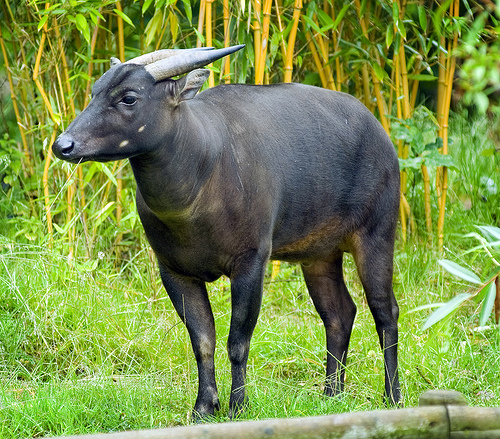
Anoa is a species endemic to the island of Sulawesi, Indonesia. Anoa also the fauna of the identity of Southeast Sulawesi province. Rare and endangered species is composed of two species (types), namely: anoa mountains (Bubalus quarlesi) and low land anoa (Bubalus depressicornis). Both of these animals live in forest that is rarely touched by humans. Both species are dwarf buffalo found only in Sulawesi, Indonesia. It is estimated that there are currently less than 5000 surviving tail. Anoa often hunted for its skin, horns and meat.
Both Anoa Mountains (Bubalus quarlesi) and Lowland Anoa (Bubalus depressicornis) since 1986 by IUCN Redlist categorized in animals with the conservation status of "Threatened Species" (Endangered, EN) or three levels below the status of "Endangered".


In general, dwarf buffalo buffalo has a similar skin color, straight horns back and pointed and somewhat flattened. His life is to move where and when enemies met anoa will defend itself with a splash into the swamp or if forced to fight by using his horns.
Lowland Anoa (Bubalus depressicornis) is often referred to as a small buffalo, because Anoa buffalo is similar, but shorter and smaller in size, about the size of goats. Species named Bubalus depressicornis Latin is referred to as Lowland Anoa, Anoa de Ilanura, or Anoa des Plaines. Anoa the fauna of Southeast Sulawesi province identity is more difficult to find than anoa mountains.
Lowland Anoa (Bubalus depressicornis) is often referred to as a small buffalo, because Anoa buffalo is similar, but shorter and smaller in size, about the size of goats. Species named Bubalus depressicornis Latin is referred to as Lowland Anoa, Anoa de Ilanura, or Anoa des Plaines. Anoa the fauna of Southeast Sulawesi province identity is more difficult to find than anoa mountains.
Anoa lowlands (Bubalus depressicornis) has a body size that is relatively more fat than a close relative anoa mountains (Bubalus quarlesi). Body length about 150 cm with a height of 85 cm. Lowland anoa Horn length 40 cm. While body weight anoa lowlands to 300 kg.
Anoa lowlands to live up to the age of 30 who are sexually mature at age 2-3 years. Anoa females give birth to one baby in each pregnancy. Pregnancy itself about 9-10 months. Children anoa will follow its mother until the age of majority although it has been weaned at the age of 9-10 months. So it is not infrequently seen with a single parent with 2 children of different ages anoa.
Anoa lowland life ranging from coastal forest habitat to upland forests with an altitude of 1000 masl. Anoa like the edge of the forest area of the river or lake considering endangered species is in addition to need water to drink too fond of bathing when the sun sting.
Anoa mountains (Bubalus quarlesi) is often referred to as Mountain Anoa, Anoa de Montagne, Anoa de Quarle, Berganoa, and Anoa de Montana. In the Latin language called Bubalus quarlesi anoa mountains.
Anoa mountains have a more slender body size compared datarn anoa low. Body length of about 122-153 cm with a height of about 75 cm. Long horn anoa mountains about 27 cm with adult body weight about 150 kg. Anoa mountains between 20-25 years old who are sexually mature at age 2-3 years. Like the lowland anoa, anoa only give birth to one baby in each pregnancy that ranged 9-10 months. Children anoa will follow its mother until the age of majority although it has been weaned at the age of 9-10 months. So it is not infrequently seen with a single parent with 2 children of different ages anoa.
Anoa berhabitat mountains in the highland forest until it reaches a height of 3000 meters above sea level, although sometimes this kind anoa visible down to the beach to get the necessary mineral salts in the process of metabolism.
Anoa mountains tend to be more active in the morning, and rest during midday. Anoa often take shelter under large trees, under overhanging rocks, and in the space beneath tree roots or wallowing in mud and pond. Dwarf buffalo horn is used to uncover the bush or digging soil surface Bumps front horn is used to show dominance, while at the fights, the tip of a sharp stab to the top is used in an attempt to injure the opponent. When excited, anoa mountains make a sound "moo".
Population and Conservation. Anoa is increasingly rare and hard to find. Even in recent years anoa lowlands (Bubalus depressicornis) The mascot of Southeast Sulawesi province were never seen again. Therefore, since 1986, IUCN Redlist incorporate both types of dwarf buffalo is in the conservation status of "endangered" (Endangered Species).
In addition, CITES also incorporate both these endangered species in Appendix I, which means should not be traded. The Indonesian government also include anoa as one of the protected animals in the Government Regulation (PP) of the Republic of Indonesia Number 7 of 1999 concerning the Preservation of Plants and Animals.
Some areas are still there are endangered species these include Lambusango Mountain Nature Reserve, the Lore-Lindu National Park and TN Swamp Aopa Watumohai (some of the suspect already extinct).
Anoa tida actually have enemies (predators) natural. The threat of extinction of species endemic to Sulawesi, is more likely caused by deforestation (agricultural land clearing and settlement) and hunting by man to take the meat, skin, and horns.
In 2000, communities in South Buton and assisted Konawe BKSDA party had tried to open a dwarf buffalo breeding. But these efforts ultimately failed because of behavior that tends anoa closed and easily disturbed by human presence so that the few species that ditangkarkan none successful breeding.
Year 2010, the Lore-Lindu National Park will try to do the breeding of this endangered species. Hopefully, these good intentions can be implemented so that low datarn anoa (Bubalus depressicornis) and Anoa Mountains (Bubalus quarlesi) can be sustainable and become the pride of the entire Indonesian nation as well as the Panzer Anoa Pindad.
Scientific classification: Kingdom: Animalia, Phylum: Chordata, Class: Mammalia, Order: Artiodactyla, Family: Bovidae, Upafamili: Bovinae, Genus: Bubalus, Species: Bubalus quarlesi, Bubalus depressicornis. Binomial Name: Bubalus quarlesi (Ouwens, 1910). Bubalus depressicornis (H. Smith, 1827).
more pictures : http://www.google.co.id/images?hl=id&q=anoa&um=1&ie=UTF-8&source=og&sa=N&tab=wi&biw=1116&bih=457

Tidak ada komentar:
Posting Komentar